English
  Spanish
  Portuguese
  Arabic
  Russian
  简体中文
简体中文 

 Location:
 In-depth analysis of Fiber Optic Cable Core: the key
 Update Time:2025-12-09
 Traffic:
In today's high-speed connected world, we talk about gigabit broadband and 5G networks every day, but few pay attention to the real heroes behind these data transmissions. When we peel off the thick protective layer of the fiber optic cable, we find a glass filament as thin as a hair. This is the Fiber Optic Cable Core.
This article will provide you with an in-depth understanding of the construction of Fiber Optic Cable Core, how it works, and how it determines the quality of your network connection.
What is Fiber Optic Cable Core?
Fiber Optic Cable Core is the most central part of the optical fiber and is the physical medium for the transmission of optical signals. It is usually made of very high purity silica (glass) or plastic.
The structure of an optical fiber is mainly composed of three layers, with the core located in the innermost layer.
Core: Light signals propagate in this region.
Cladding (cladding): wrapped outside the core, its refractive index is slightly lower than the core, the purpose is to "lock" the light in the core.
Coating: The outermost protective layer used to prevent physical damage.

Shutterstock
Note: Light can be transmitted because it has Total Internal Reflection at the interface between Core and Cladding. If the Core is damaged or of poor quality, the optical signal can leak, causing network outages or extremely slow speeds.
Core classification: the difference between single mode and multimode
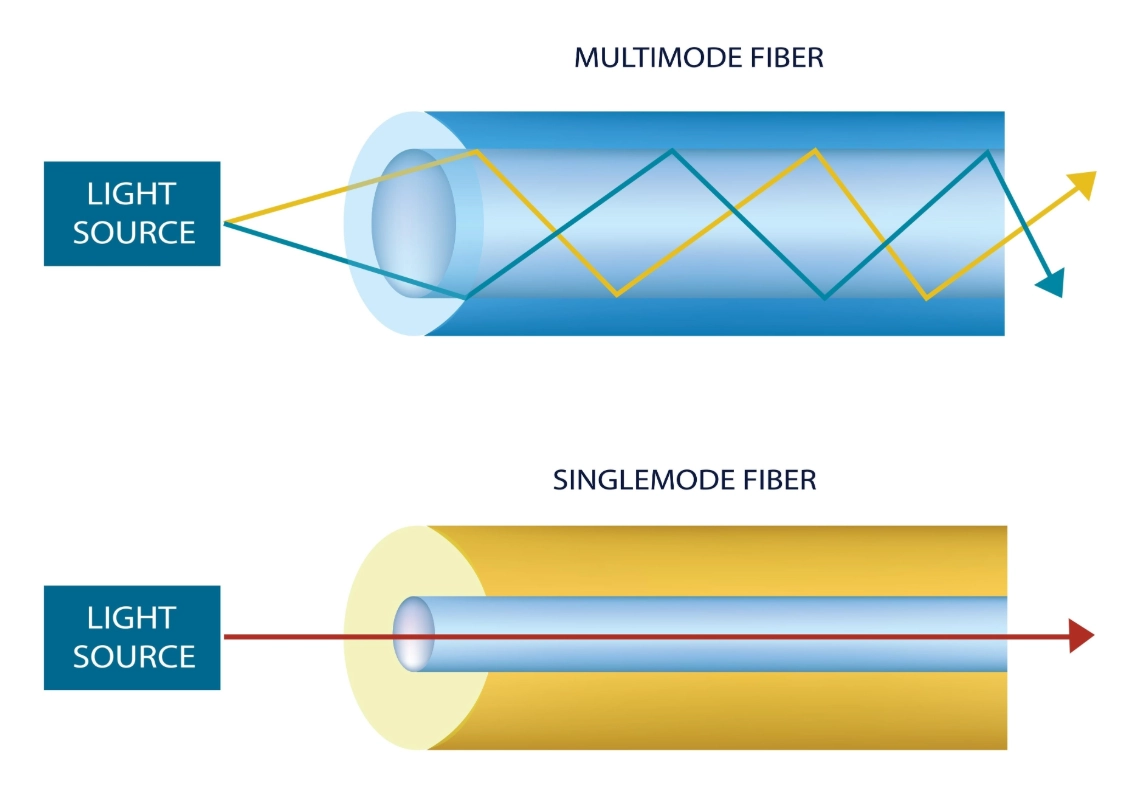
When discussing Fiber Optic Cable Core, the most important parameter is its diameter. Depending on the diameter of the core, fibers are mainly divided into two categories: single-mode fibers and multi-mode fibers.
1. Single-mode fiber
Core diameter: very fine, usually 9 µm (micrometers).
Transmission characteristics: Due to the extremely thin core, light can only travel in a single mode (path) in a straight line.
Application scenarios: long-distance transmission (e.g. submarine cables, inter-city connections).
Advantages: The signal attenuation is extremely low, and the transmission distance can reach tens of kilometers without the need for a relay.
2. Multi-mode fiber
Core diameter: Coarser, usually 50 µm or 62.5 µm.
Transmission characteristics: The thicker core allows light to travel in multiple modes (with different reflection angles).
Application scenarios: short-distance transmission (e.g. data center interior, office building LAN).
Disadvantages: It is prone to modal dispersion, which limits the transmission distance and bandwidth.
Shutterstock
Core parameter comparison table
| characteristic | single-mode fiber (Single-mode) | Multimode fiber (Multi-mode) |
| Fiber Optic Cable Core diameter | ~9 µm | 50 μm or 62.5 μm |
| light source | Laser (Laser) | LED or VCSEL |
| transmission distance | Long distance (> 10km) | Short distance (< 550m) |
| cost | Fiber optic cables are cheap, but equipment is expensive | Fiber optic cables are a little more expensive, equipment is cheap |
| bandwidth potential | Almost unlimited | finite |
Material Analysis: Glass vs. Plastic
Although most high-performance networks use glass cores, the material of Fiber Optic Cable Cores can vary depending on the application.
Glass Core
Ingredient: Pure silica.
Features: Extremely low loss, high temperature resistance, best transmission performance.
Purpose: Telecommunications network, Internet backbone network.
Plastic Optical Fiber (POF - Plastic Optical Fiber)
Ingredients: PMMA (polymethyl methacrylate) or polystyrene.
Core diameter: very large, usually around 1 mm.
Features: Low cost, good flexibility, easy to install, but high signal attenuation.
Purpose: Home audio connection (Toslink), automotive internal communication, short-range industrial control.
Why is Fiber Optic Cable Core Cleanliness Important?
In fiber maintenance, there is a golden rule: "Keep the end face clean".
Since the diameter of Fiber Optic Cable Core (especially single-mode fiber) is only 9 microns, it is even smaller than a grain of dust. What happens if the end face of the core is contaminated with dust, oil or fingerprints?
Light path blocking: Dust directly blocks the path of the light signal.
Backward reflection: Dirt can cause light signals to reflect back to the light source, damaging expensive transmission equipment.
Permanent damage: High-power lasers generate heat when they encounter dust, which can burn the end face of the core.
Expert advice: Before connecting any fiber optic jumpers, be sure to wipe the end face of the Fiber Optic Cable Core with a professional fiber optic cleaning pen or clean paper.
Frequently Asked Questions (FAQ)
To better answer your questions, we've compiled a list of frequently asked search questions about Fiber Optic Cable Core:
Q1: Does the diameter of Fiber Optic Cable Core affect the network speed?
Yes. Although the diameter itself does not directly represent speed (the speed of light is constant), the type of core determines the bandwidth capacity. Single-mode cores (thinner) typically support higher bandwidths and longer distances.
Q2: How do I know which core I am using?
It can usually be judged by the color of the cable sheath.
Yellow usually represents single mode (9 µm Core).
Orange or aqua blue typically represents multimode (50 µm Core).
Q3: Fiber Optic Cable Core 会断吗?
Although the glass core has some flexibility, if the bending angle exceeds its "minimum bending radius" or is strongly squeezed, the core will break, causing the signal to be interrupted.
summarize
Fiber Optic Cable Core is the cornerstone of modern communication technology. Whether it is a hair-thin single-mode core or a multi-mode core for short-distance transmission, understanding the differences between them can help us better plan network architectures and troubleshoot.
With the development of 5G and data center technology, the demand for higher purity and lower loss Fiber Optic Cable Core will continue to grow. The next time you enjoy the speed of the network, don't forget to thank that invisible glass core.